
In my last post about the Emperor card from Meditations on the Tarot, I mentioned the necessity of living what we've learned. Real Magic by Dr. Wayne W. Dyer is about how to do that. It's marketed as a self-help book, so you won't see it in the "New Age" section of the bookstore, but there's plenty here for us recovering materialists. In fact, you'll be surprised to learn that I don't recommend this book for beginners. It's not that beginners won't understand it; the concepts are presented in a very clear and accessible manner. The danger is that beginners won't understand fully. I'll explain.
The key concept given in the book is that matter follows mind. If you're a beginner, or still in denial as a materialist, this will just seem like another silly New Age book. And if you get the idea that it's just something like repeating an affirmation to yourself until you believe it, you'll totally miss the point. On the other hand, if you've spent some time studying qabalah, especially the Tree of Life and the Four Worlds, you'll recognize the principle as self-evident. And you'll not only know it works, you'll know why it works.
So what exactly can we learn from this book? First, you can expect to have your mind changed about what is possible. Next, a new spiritual approach is given. This approach is surprisingly similar to what's said in Meditations about the Magician. At this point you'll be prepared to start doing divine magic (the Empress in Meditations) in your own life and the lives of those close to you.
The second half of the book goes into more details about real-life applications of the principles given. Relationships, finances, recovery from addictions, and health are all covered. The last part of the book is a call to action, inviting you to join "The Evolution."
This book definitely belongs on your shelf, and should be read at least twice.
Showing posts with label recovery. Show all posts
Showing posts with label recovery. Show all posts
Saturday, August 15, 2009


Sunday, March 15, 2009
Next Steps on the Hermetic Path
So you've read a couple of books and want to know what to do next. The next thing is detailed study of the four major fields of hermetism: qabalah, astrology, tarot and alchemy. Studying these four fields together will help your progress as the four are interdependent. You'll see that for yourself as you progress. Ritual magic is optional at this stage, and ceremonial magic is right out.
If you're reading Kabbalah, Magic & the Great Work of Self Transformation: A Complete Course and like the program given, you should follow it, at least for now. The important thing is to not hurry; there's a lot of information, and it takes time for it to sink in.
For the rest of you, the first book I recommend you read at this point is Kabbalistic Handbook for the Practicing Magician . The book gives very good basic information about Qabalah, but more importantly, it will give you an effective study method. And study you will, if you choose this path. This book recommends studying A Garden of Pomegranates: Skrying on the Tree of Life
 and The Essential Kabbalah: The Heart of Jewish Mysticism
 as qabalah books to read first, and I agree with this recommendation.
A good place to start with tarot is Tarot Awareness -- Exploring the Spiritual Path , or Learning the Tarot: A Tarot Book for Beginners
 if you can't get a copy of Tarot Awareness. For astrology, start with Astrology for Yourself: How to Understand And Interpret Your Own Birth Chart
 or Astrology for the Light Side of the Brain
 . Finally, for alchemy, start with The Complete Idiot's Guide to Alchemy
 .
.
At this point you may also want to consider group work. There are many choices here, but I recommend B.O.T.A.
Just so you know what you've gotten yourself into, I was looking at a tarot book (I forget which one) and saw a statement comparing learning tarot to learning chess. There's only a few basic concepts, but years are needed for mastery. The other fields of hermetism have the same characteristic. But at least you'll have something to do for a while.
If you're reading Kabbalah, Magic & the Great Work of Self Transformation: A Complete Course
and like the program given, you should follow it, at least for now. The important thing is to not hurry; there's a lot of information, and it takes time for it to sink in. For the rest of you, the first book I recommend you read at this point is Kabbalistic Handbook for the Practicing Magician
. The book gives very good basic information about Qabalah, but more importantly, it will give you an effective study method. And study you will, if you choose this path. This book recommends studying A Garden of Pomegranates: Skrying on the Tree of Life and The Essential Kabbalah: The Heart of Jewish Mysticism as qabalah books to read first, and I agree with this recommendation.A good place to start with tarot is Tarot Awareness -- Exploring the Spiritual Path
, or Learning the Tarot: A Tarot Book for Beginners if you can't get a copy of Tarot Awareness. For astrology, start with Astrology for Yourself: How to Understand And Interpret Your Own Birth Chart or Astrology for the Light Side of the Brain. Finally, for alchemy, start with The Complete Idiot's Guide to Alchemy.At this point you may also want to consider group work. There are many choices here, but I recommend B.O.T.A.
Just so you know what you've gotten yourself into, I was looking at a tarot book (I forget which one) and saw a statement comparing learning tarot to learning chess. There's only a few basic concepts, but years are needed for mastery. The other fields of hermetism have the same characteristic. But at least you'll have something to do for a while.
Tuesday, March 10, 2009
Next Steps on the Mystic Path
I'm sure most of you reading this have already read my post on getting started. If not, you may want to now, because I'm going to talk today about what to do next if you've chosen the mystic path. The hermetic path will be another post, because the reading materials will be different.
Now just to refresh your memory, the mystic path aims at an eventual direct experience of the underlying unity of all things. One of the things that prevents this experience is negativity. For most of us, it comes in the form of projection. The best antidote for this is A Course in Miracles . The book says that you can read it in any order, but I recommend you start with the text. Don't rush things; just read a couple of sections per sitting. This will allow time for the ideas in the book to sink in. When you're ready, start the workbook exercises. Don't try to do more than one exercise per day. You can peek at the teacher's manual if you want, but I don't think it will do you much good until you finish the text and workbook.
Some of you may have a different problem: fundamentalist materialism. Expanding your concept of the universe is key here, and the answer is Kabbalah. The Berg brothers, who run the Kabbalah Centre, have many good introductory books. You'll immediately notice parallels between their version of the creation story and materialist science's Big Bang theory.
The third obstacle to Unity Consciousness is repression, where the less desirable parts of our mind are pushed beneath the surface. How do you know if this applies to you? If you're sure that you think only positive thoughts about yourself and others, it applies. If this is the case, you can try the mystic path, but I recommend the hermetic path for you, as it has some things that will allow you to get out of your own way. Stay tuned for my next post.
You may also want to look into Eastern philosophy. The Tao Te Ching: A New English Version (Perennial Classics) is good, but not for beginners. The The I Ching or Book of Changes
 is a bit more accessible, but far deeper than it seems. Everyday Zen: Love and Work (Plus)
 is a good starting point.
Stay tuned for the next steps on the hermetic path.
Now just to refresh your memory, the mystic path aims at an eventual direct experience of the underlying unity of all things. One of the things that prevents this experience is negativity. For most of us, it comes in the form of projection. The best antidote for this is A Course in Miracles
. The book says that you can read it in any order, but I recommend you start with the text. Don't rush things; just read a couple of sections per sitting. This will allow time for the ideas in the book to sink in. When you're ready, start the workbook exercises. Don't try to do more than one exercise per day. You can peek at the teacher's manual if you want, but I don't think it will do you much good until you finish the text and workbook. Some of you may have a different problem: fundamentalist materialism. Expanding your concept of the universe is key here, and the answer is Kabbalah. The Berg brothers, who run the Kabbalah Centre, have many good introductory books. You'll immediately notice parallels between their version of the creation story and materialist science's Big Bang theory.
The third obstacle to Unity Consciousness is repression, where the less desirable parts of our mind are pushed beneath the surface. How do you know if this applies to you? If you're sure that you think only positive thoughts about yourself and others, it applies. If this is the case, you can try the mystic path, but I recommend the hermetic path for you, as it has some things that will allow you to get out of your own way. Stay tuned for my next post.
You may also want to look into Eastern philosophy. The Tao Te Ching: A New English Version (Perennial Classics)
is good, but not for beginners. The The I Ching or Book of Changes is a bit more accessible, but far deeper than it seems. Everyday Zen: Love and Work (Plus) is a good starting point. Stay tuned for the next steps on the hermetic path.
Monday, February 23, 2009
Getting Started
It's been a while since I talked about how to get started on the road to recovery from materialism, so an updated roadmap is probably in order. The first important thing is that you have to start where you are. That sounds trivial, but hear me out. There may be a lot of learning ahead on whatever path you choose, especially if it's one of the hermetic paths, but there is also a lot of unlearning that needs to be done.
So, let's say you come from a Roman Catholic background as I did. You could decide to immerse yourself in Zen Buddhism. It may work for you, and you could make progress, but your background doesn't go away. It's still there, and you'll have to come to terms with it, sooner or later. On the other hand, if you start with the Hermetic path, you'll be in somewhat familiar territory. You'll run across correspondences to things you already know. You'll hit the ground running, as it were.
That said, a good place to start is the "New Age"/metaphysical section of your local bookstore. Pick any book that looks interesting and start reading. If any veterans are reading this, don't worry. I haven't forgotten Sturgeon's Law; it's just that some things have to be learned through experience, and this is one of them. The type of person who believes everything they read will be led astray regardless.
Once you've looked through a few books, you should have an idea of what specifically interests you, and the general direction in which you want to proceed. If you want to study astrology, go for it. The same applies with Tarot and Wicca, though I draw the line at numerology (just kidding). Even the channeled books by Ramtha or Kryon (or the Urantia Book if you're desperate) will be helpful. The point I'm trying to make is that you're going to have to wade through a lot of muck to find the good stuff that's under it, so you may as well start now.
Now you're ready to choose one of the two paths. There's no wrong answer to this question. The relevant quote is: "In the end we all become mystics." The mystic path aims at experience of unity with God and the universe. The hermetic path has the same eventual aim, but uses symbolism to balance out the different components of the personality. If you like symbolism, ritual, nice pictures and the like, choose the hermetic path. Otherwise, the mystic.
Now for reading material. If you're on the mystic path, the choice is relatively simple: Path of Light: Stepping into Peace with "A Course in Miracles" or The Disappearance of the Universe: Straight Talk About Illusions, Past Lives, Religion, Sex, Politics, and the Miracles of Forgiveness
 or anything by Marianne Williamson, followed by A Course in Miracles
 .
.
If you're on the hermetic path, The Chicken Qabalah of Rabbi Lamed Ben Clifford: Dilettante's Guide to What You Do and Do Not Need to Know to Become a Qabalist or Tarot Awareness: Exploring the Spiritual Path
 would be a good start, or Kabbalah, Magic & the Great Work of Self Transformation: A Complete Course if you're especially adventurous.
That should be enough to get any of you newbies started. Later, I'll talk about the next step.
So, let's say you come from a Roman Catholic background as I did. You could decide to immerse yourself in Zen Buddhism. It may work for you, and you could make progress, but your background doesn't go away. It's still there, and you'll have to come to terms with it, sooner or later. On the other hand, if you start with the Hermetic path, you'll be in somewhat familiar territory. You'll run across correspondences to things you already know. You'll hit the ground running, as it were.
That said, a good place to start is the "New Age"/metaphysical section of your local bookstore. Pick any book that looks interesting and start reading. If any veterans are reading this, don't worry. I haven't forgotten Sturgeon's Law; it's just that some things have to be learned through experience, and this is one of them. The type of person who believes everything they read will be led astray regardless.
Once you've looked through a few books, you should have an idea of what specifically interests you, and the general direction in which you want to proceed. If you want to study astrology, go for it. The same applies with Tarot and Wicca, though I draw the line at numerology (just kidding). Even the channeled books by Ramtha or Kryon (or the Urantia Book if you're desperate) will be helpful. The point I'm trying to make is that you're going to have to wade through a lot of muck to find the good stuff that's under it, so you may as well start now.
Now you're ready to choose one of the two paths. There's no wrong answer to this question. The relevant quote is: "In the end we all become mystics." The mystic path aims at experience of unity with God and the universe. The hermetic path has the same eventual aim, but uses symbolism to balance out the different components of the personality. If you like symbolism, ritual, nice pictures and the like, choose the hermetic path. Otherwise, the mystic.
Now for reading material. If you're on the mystic path, the choice is relatively simple: Path of Light: Stepping into Peace with "A Course in Miracles"
or The Disappearance of the Universe: Straight Talk About Illusions, Past Lives, Religion, Sex, Politics, and the Miracles of Forgiveness or anything by Marianne Williamson, followed by A Course in Miracles.If you're on the hermetic path, The Chicken Qabalah of Rabbi Lamed Ben Clifford: Dilettante's Guide to What You Do and Do Not Need to Know to Become a Qabalist
or Tarot Awareness: Exploring the Spiritual Path would be a good start, or Kabbalah, Magic & the Great Work of Self Transformation: A Complete Course if you're especially adventurous.That should be enough to get any of you newbies started. Later, I'll talk about the next step.
Thursday, January 22, 2009
What is a Mystery School?
In an earlier post, I said that a mystery school was a support group for recovering materialists. While true, that description is not precise enough. Mystery schools are strictly for the hermetic path of recovery, that path that emphasizes balancing the different components of the personality using symbol systems with an eventual goal of realization of Unity Consciousness. There are support groups for people on the mystic path, but they go by different names: churches, ashrams and the like.
That said, there are many mystery schools, but this is my favorite. So what can you expect from a mystery school? A good mystery school will provide the following:
That said, there are many mystery schools, but this is my favorite. So what can you expect from a mystery school? A good mystery school will provide the following:
- lessons explaining the group's doctrine
- a knowledge base or reading list
- the opportunity for group work
Monday, December 15, 2008
"What If?" The Movie - Clip 1
I was recently sent a clip from a new movie called What If? The Movie. The clip shows Dr. Bruce Lipton explaining epigenetics:
What If? Epigenetics Description
I've read Dr. Lipton's book, The Biology of Belief. His part in the movie should be very interesting. My only complaint is that the clip is short (about 20 seconds).
I'm told there are 3 more clips coming. Stay tuned.
What If? Epigenetics Description
I've read Dr. Lipton's book, The Biology of Belief. His part in the movie should be very interesting. My only complaint is that the clip is short (about 20 seconds).
I'm told there are 3 more clips coming. Stay tuned.
Saturday, December 13, 2008
Book Review: Astrology, A Cosmic Science
I've been studying astrology for a couple of months, and I've looked through a few books on the subject. My favorite so far is Astrology: A Cosmic Science by Isabel Hickey. What makes this book different is its approach to astrology. Your chart does not so much describe your inherent nature as much as lay out a blueprint for your future evolution. Positive aspects and planetary placements are seen as things that come easy, or potentials to develop; negative aspects and placements are seen as lessons that must be learned.
An interesting idea in the book, which I've seen in a couple of other places, is that you don't get the characteristics of your sun sign by default. That is because most people are driven by their emotions, which are governed by the moon sign. The sun sign actually reflects your true inner nature, and it must be brought out. The ascendant determines how you appear to others. All twelve Zodiac signs have an influence on each of us because they appear in at least one of the twelve houses. Just to give you an example of the book's approach, here's how the Scorpio ascendant is described:
If you only buy one astrology book, this book would be a good choice.
An interesting idea in the book, which I've seen in a couple of other places, is that you don't get the characteristics of your sun sign by default. That is because most people are driven by their emotions, which are governed by the moon sign. The sun sign actually reflects your true inner nature, and it must be brought out. The ascendant determines how you appear to others. All twelve Zodiac signs have an influence on each of us because they appear in at least one of the twelve houses. Just to give you an example of the book's approach, here's how the Scorpio ascendant is described:
The hardest Ascendant of all. Battlefield where the soul and personality must come to mortal combat. They must come into alignment and the personality must die...No unevolved soul is born with a Scorpio Ascendant. The razor-edged path that can only be tread when there is strength and power enough to do so...So the theme of this book suggests a good approach to astrology: use the chart to show what lessons have to be learned in this lifetime, and leave the fortune-telling to the newspaper crowd.
If you only buy one astrology book, this book would be a good choice.
Monday, December 8, 2008
Tarot Court Cards
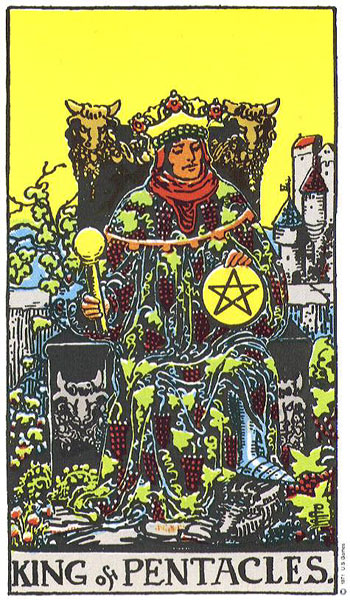
I'm still reading Learning the Tarot: A Tarot Book for Beginners
by Joan Bunning. I understand the court cards a lot better now after reading this lesson.The traditional attribution of the court cards is as follows: the Page represents earth, the Knight air, the Queen water, and the King fire. This didn't make much sense to me given that the four suits have similar attributions. But what makes more sense, and I think Ms. Bunning was trying to get at this, is that the Page, Knight, Queen and King actually correspond to the four worlds of qabalah. The four worlds are typically explained in terms of the manifestation of things and events, but in this case, they refer to evolution, specifically our evolution. In other words, recovery from materialism.
Under this interpretation, the page represents the starting point: the realization of the need for recovery and the initial efforts. The knight represents the initial exploration of the element given. The queen represents embodiment of the principles represented by the element, and the king represents mastery. The elements are as follows: pentacles represent the body and the material world, swords represent the intellect, cups represent the emotions and wands represent spirit and creativity.
If we can combine in ourselves the qualities of the king of each suit, we'll be well on the way to recovery. I don't know how to do this yet, but I have reason to believe that I'll find out.
Sunday, November 30, 2008
Book Review: Pregnant Darkness
Pregnant Darkness: Alchemy and the Rebirth of Consciousness by Monika Wikman is an excellent introduction to Jungian psychology and the use of alchemy for personal transformation. My guess is that "pregnant darkness" refers to the subconscious mind and the wealth of treasures there if you know how to look for them. Dreams are prominent in the book as indicators of progress and what needs to be worked on.
Alchemy is the art and science of transformation. In the case of this book, what is being transformed is yourself. The important concepts in alchemy, for example, the philosophers' stone and the first matter, are explained in relation to psychology. Mythology is used to help explain the concepts. The story of King Midas, for example, is given as an illustration of what happens when you refuse to admit when you're being a jackass. That points to what seems to be a prevailing theme of the book: don't be afraid to get your hands dirty and own up to your shadow self. And that makes sense. After all, isn't admitting there's a problem the first step of recovery?
This book is not for newbies, but should prove very helpful with some background knowledge.
Alchemy is the art and science of transformation. In the case of this book, what is being transformed is yourself. The important concepts in alchemy, for example, the philosophers' stone and the first matter, are explained in relation to psychology. Mythology is used to help explain the concepts. The story of King Midas, for example, is given as an illustration of what happens when you refuse to admit when you're being a jackass. That points to what seems to be a prevailing theme of the book: don't be afraid to get your hands dirty and own up to your shadow self. And that makes sense. After all, isn't admitting there's a problem the first step of recovery?
This book is not for newbies, but should prove very helpful with some background knowledge.
Thursday, November 27, 2008
A Recovering Materialist Thanksgiving
If you're like most people I know, you'll spend your Thanksgiving doing one or more of the following things: watching one or more of the parades; watching one or more of the football games; eating dinner with the family. Some of us will also take some time to be thankful for the things we have: our families, homes, health, that sort of thing.
Those of us who are recovering materialists will take this one step further. Both the hermetic and mystic traditions affirm that we both have and are more than we know, even more than we can imagine. Maybe we can't be thankful for these things because we don't know what they are, but rest assured that there's a part of us that knows exactly, and is infinitely thankful.
Happy Thanksgiving!
Those of us who are recovering materialists will take this one step further. Both the hermetic and mystic traditions affirm that we both have and are more than we know, even more than we can imagine. Maybe we can't be thankful for these things because we don't know what they are, but rest assured that there's a part of us that knows exactly, and is infinitely thankful.
Happy Thanksgiving!
Sunday, November 9, 2008
Book Review: Cloud upon the Sanctuary
Did you ever have the feeling that someone "up there" was looking out for you? Or in the alternative, do you agree with the Matrix guys who think we're being farmed like sheep? And is there really any difference? Either way, we're being monitored by beings much smarter (or more powerful) than us for reasons we can't determine. But enough paranoia. Let's look at the positive side of this idea.
Cloud upon the Sanctuary by Karl von Eckartshausen is a classic work of hermeticism based on the idea that there is a body of knowledge being held in escrow for us, to be released when we're ready for it. In the meantime, symbols pointing to that knowledge are spread throughout the world's cultures and religions.
When will we be ready? Those of us who realize that there's more to the world than can be measured by our scientific instruments, and that there's more to religion than rules and rituals, have already started the journey. Contact with people who have more information, either directly or through books, is inevitable at that point.
Will this book help you get ready? Probably not, at least not by itself. But it does point to the pot of gold at the end of the rainbow, and sometimes knowing the pot is there can be helpful.
Cloud upon the Sanctuary by Karl von Eckartshausen is a classic work of hermeticism based on the idea that there is a body of knowledge being held in escrow for us, to be released when we're ready for it. In the meantime, symbols pointing to that knowledge are spread throughout the world's cultures and religions.
When will we be ready? Those of us who realize that there's more to the world than can be measured by our scientific instruments, and that there's more to religion than rules and rituals, have already started the journey. Contact with people who have more information, either directly or through books, is inevitable at that point.
Will this book help you get ready? Probably not, at least not by itself. But it does point to the pot of gold at the end of the rainbow, and sometimes knowing the pot is there can be helpful.
Wednesday, November 5, 2008
Book Review: Enchanted Love
One side effect of recovery from materialism that I've noticed is that life seems to take on a quality that can only be described as magical. The Course in Miracles says that is by design. Miracles are supposed to happen; we just need to get out of our own way.
But how does this relate to love? What most people think of as romantic love is better described as a combination of need and fear. The neediness and fear drive jealously and possessiveness. But when you get rid of that, what's left? The problem with unconditional love is it's inherently universal, and if everybody's somebody, then nobody's anybody.
Marianne Williamson, one of the most prominent authors who write about The Course, has the answer in her book Enchanted Love: The Mystical Power of Intimate Relationships. She says that romantic love is vital because "heaven is entered two by two." Any of us who have been in a serious relationship will know that it can show you the very worst aspects of your partner and your self. This is a good thing. According to the course (and most psychologists), the traits we dislike the most in other people are really parts of ourselves that we disown and project onto them. By bringing these traits to the surface, an intimate relationship gives us the opportunity to accept them, which is of course a prerequisite for real change.
I could go on and on about the book, so I'll close by saying that Ms. Williamson has obviously learned a lot about love, presumably the hard way. Her book can same you some time in creating the real thing for yourself. I cannot recommend it highly enough.
But how does this relate to love? What most people think of as romantic love is better described as a combination of need and fear. The neediness and fear drive jealously and possessiveness. But when you get rid of that, what's left? The problem with unconditional love is it's inherently universal, and if everybody's somebody, then nobody's anybody.
Marianne Williamson, one of the most prominent authors who write about The Course, has the answer in her book Enchanted Love: The Mystical Power of Intimate Relationships. She says that romantic love is vital because "heaven is entered two by two." Any of us who have been in a serious relationship will know that it can show you the very worst aspects of your partner and your self. This is a good thing. According to the course (and most psychologists), the traits we dislike the most in other people are really parts of ourselves that we disown and project onto them. By bringing these traits to the surface, an intimate relationship gives us the opportunity to accept them, which is of course a prerequisite for real change.
I could go on and on about the book, so I'll close by saying that Ms. Williamson has obviously learned a lot about love, presumably the hard way. Her book can same you some time in creating the real thing for yourself. I cannot recommend it highly enough.
Sunday, November 2, 2008
Recovering Materialist Politics
After a recent argument with a couple of friends over why I wasn't voting for Obama (or anyone else), I started thinking about my political philosophy, and the fact that it hadn't been updated to reflect what I've learned in the past few years. The first concept that comes to mind is the Taoist idea that people who are living right don't need laws. An obvious corollary is that if everyone is living right, laws become irrelevant. I'm sure there are other applicable ideas, and if you happen to think of any, please leave a comment.
Now, why am I not voting for Obama? The same reason I didn't vote for Clinton or either of the Bushes. I won't vote for anyone unless I know their philosophy and agree with it. The "lesser of two evils" or "at least it's a step in the right direction" will happen just as well without my help. At least 30 percent of the population will think it's the wrong direction anyway.
Thinking about the argument raised an important question: how do we deal with others who we think have suboptimal beliefs or behaviors? This seems to me to be the central question in politics. A possible answer is the use of force, and if you're in favor of laws against "victimless crimes" or mandatory anything, this is your answer. Another answer is that we leave them alone and insulate ourselves from the results or their beliefs or actions as best we can; this is the Libertarian philosophy in a nutshell. A third answer is the use of persuasion. Can you think of any others? Again, please leave comments.
Now, why am I not voting for Obama? The same reason I didn't vote for Clinton or either of the Bushes. I won't vote for anyone unless I know their philosophy and agree with it. The "lesser of two evils" or "at least it's a step in the right direction" will happen just as well without my help. At least 30 percent of the population will think it's the wrong direction anyway.
Thinking about the argument raised an important question: how do we deal with others who we think have suboptimal beliefs or behaviors? This seems to me to be the central question in politics. A possible answer is the use of force, and if you're in favor of laws against "victimless crimes" or mandatory anything, this is your answer. Another answer is that we leave them alone and insulate ourselves from the results or their beliefs or actions as best we can; this is the Libertarian philosophy in a nutshell. A third answer is the use of persuasion. Can you think of any others? Again, please leave comments.
Tuesday, August 19, 2008
Read Some Science Fiction Today
For a recovering materialist, the most important thing is getting rid of what I like to call "the baggage": a collection of beliefs that no longer work for us. The worst of these beliefs concern limitation: the things we think we could never do; both things we could never do because they are "impossible" and things that we could never do because they are beneath us. Science fiction and fantasy novels can be used to help expand our conceptions of what is possible.
Good science fiction says "What if?" It shows us worlds that we think are impossible given current knowledge of the laws of nature. It shows us parts of ourselves that we didn't know we had. It invokes myths and archetypes that echo in the depths of our minds.
A good novel will induce you to identify with the main character. This is a good thing. A good novel also creates a picture of its world inside your head. This is also a good thing, because the picture will involve the above-mentioned myths and archetypes. These myths and archetypes refer to things that are a part of all of us, but mostly unrecognized. The references in the novels will lay the foundation for future mystic and/or hermetic work. The symbols are in your head now, and when you learn the meaning of them later, the meaning will seem familiar to you.
So don't feel bad if you're over 30 and still reading Harry Potter. It may be that you need some magic in your life. Getting the germ of an idea in your head that magic is possible will prepare you to find the real thing.
Good science fiction says "What if?" It shows us worlds that we think are impossible given current knowledge of the laws of nature. It shows us parts of ourselves that we didn't know we had. It invokes myths and archetypes that echo in the depths of our minds.
A good novel will induce you to identify with the main character. This is a good thing. A good novel also creates a picture of its world inside your head. This is also a good thing, because the picture will involve the above-mentioned myths and archetypes. These myths and archetypes refer to things that are a part of all of us, but mostly unrecognized. The references in the novels will lay the foundation for future mystic and/or hermetic work. The symbols are in your head now, and when you learn the meaning of them later, the meaning will seem familiar to you.
So don't feel bad if you're over 30 and still reading Harry Potter. It may be that you need some magic in your life. Getting the germ of an idea in your head that magic is possible will prepare you to find the real thing.
Monday, July 28, 2008
Are We Ready for Obama?
I have noticed in the liberals I have known a firm belief that everything would be fine if only we could get the right people into office. From what I've heard and read about Barack Obama, he seems to be one of the "right people." When Obama won the nomination, my first thought was that the liberals would finally get their wish, but that it wouldn't work. The current system is too firmly entrenched for one person to change it, assuming he actually tries to do what he says he will do, which would be a first.
What I believe now is that electing Obama will work if we work. I'll explain shortly, but first I have to cover a couple of terms that may not be familiar to everyone: microcosm and macrocosm. A good literal interpretation would be that microcosm means "small universe" and macrocosm means "large universe." Now to the point: America's current situation, with the economy, war, environment, and so forth, is a macrocosm. The situations of individual Americans are corresponding microcosms. I use the word "corresponding" because the doctrine of correspondence ("As above, so below") is one of the basic tenets of hermeticism. Simply put, in order to fix our country, we also have to fix ourselves.
As an example, let's talk about the economy. You can blame greedy speculators if you want, but the major cause of our economic problems is that the government has been spending more than it gets for years. This has caused a drop in the dollar's value, and a corresponding increase in oil and other prices. This corresponds to the main problem of many Americans (including myself): we are in debt up to our eyeballs. Both problems must be addressed in order to fix the economy.
I think you get the point, and I'm starting to sound preachy, so I'll stop. The bottom line is that if Obama wins, he's going to need lots of help. We can help him by doing the right thing for ourselves. I'll get off the soapbox now. Thanks for listening.
What I believe now is that electing Obama will work if we work. I'll explain shortly, but first I have to cover a couple of terms that may not be familiar to everyone: microcosm and macrocosm. A good literal interpretation would be that microcosm means "small universe" and macrocosm means "large universe." Now to the point: America's current situation, with the economy, war, environment, and so forth, is a macrocosm. The situations of individual Americans are corresponding microcosms. I use the word "corresponding" because the doctrine of correspondence ("As above, so below") is one of the basic tenets of hermeticism. Simply put, in order to fix our country, we also have to fix ourselves.
As an example, let's talk about the economy. You can blame greedy speculators if you want, but the major cause of our economic problems is that the government has been spending more than it gets for years. This has caused a drop in the dollar's value, and a corresponding increase in oil and other prices. This corresponds to the main problem of many Americans (including myself): we are in debt up to our eyeballs. Both problems must be addressed in order to fix the economy.
I think you get the point, and I'm starting to sound preachy, so I'll stop. The bottom line is that if Obama wins, he's going to need lots of help. We can help him by doing the right thing for ourselves. I'll get off the soapbox now. Thanks for listening.
Sunday, July 20, 2008
Book Review: A Course in Miracles
A Course in Miracles is a textbook for those on the mystic path to recovery. It contains 4 parts: the textbook, a set of exercises, a teacher's manual, and a glossary. This book is channeled; like all channeled books, the important question is: "have they got anything useful to say?" In this case, the answer is an unqualified "Yes!" In addition to a viable roadmap to the mystic path, there are some interesting interpretations of the Bible, one of which I'll talk about below.
As I mentioned before, the mystic path aims at direct experience of unity with God (or the Universe, if you prefer). Before this can happen, the "baggage" must be dealt with. The Course has a unique way of dealing with it: forgiveness. You deal with your baggage by forgiving what you see of it in others. However, the Course has an unconventional definition of forgiveness. It doesn't mean "you've done something terrible to me, but I forgive you"; it means "you've seemingly done something terrible to me, but what I really am cannot be hurt, so there is nothing to forgive." The extreme case is given by the Crucifixion, where Jesus said: "Father, forgive them. They know not what they do."
So how does this relate to baggage? It is a principle of psychology that what we hate most in others is the traits of ourselves that we push below the surface. Therefore, by forgiving them in others, we also forgive them in ourselves. As an example, have you ever been driving and had another car tailgating you and swerving back and forth to get your attention? If so, you probably have also been behind another car that was driving much to slowly and got a little impatient about it. The two situations are really two sides of the same coin. So if you can forgive the tailgater, you can also forgive yourself for secretly wanting to apply high explosives to the slow car in front of you.
Now for the workbook exercises: these are designed to be done no more than one per day. If it takes you more than one day to do an exercise, or you skip a day, don't worry about it. Each exercise consists of an idea that is to be applied in short sessions, and throughout the day. There are 365 of them, but, like I said, don't worry if it takes you more than a year to do them all. (Just between us, I only got through about 40.) The first half of the exercises is designed to erase your current way of perceiving the world, in order to make room for the perception given by the second half.
You can read the teacher's manual now if you really want to. The Course Police won't break down your door and arrest you. You'll probably get more out of it if you read the text first and do all of the exercises.
The bottom line? I've chosen the hermetic path, but I'm still reading the book. You should too.
Wednesday, July 16, 2008
Book Review: The Book on the Taboo Against Knowing Who You Are
I read anything I can written by Alan Watts; I recommend that you do the same. The Book on the Taboo Against Knowing Who You Are is a good place to start. He has also written very good books about Zen and the Tao. "The Book" is an excellent introduction to the issues we face as recovering materialists.
The first chapter of the book reads like a mission statement: if there was a book for young people containing what they needed to know to lead fulfilling lives, what would be in the book? The answer relates to our first step: it is that our perception of the world is incorrect. We are not just separate personalities; we are also connected at a very deep level.
Let's talk about personality. The word comes from the Latin word "persona," meaning "mask." Our personalities are like masks that we wear when we interact with others. They are not us, except on a superficial level. The third chapter of the book, entitled "How to be a Genuine Fake," deals with this issue, and the paradox of being a "real person," which implies that one can make something real out of what is essentially an act!
This book would be a good start for all recovering materialists, especially those who have chosen the mystic path.
The first chapter of the book reads like a mission statement: if there was a book for young people containing what they needed to know to lead fulfilling lives, what would be in the book? The answer relates to our first step: it is that our perception of the world is incorrect. We are not just separate personalities; we are also connected at a very deep level.
Let's talk about personality. The word comes from the Latin word "persona," meaning "mask." Our personalities are like masks that we wear when we interact with others. They are not us, except on a superficial level. The third chapter of the book, entitled "How to be a Genuine Fake," deals with this issue, and the paradox of being a "real person," which implies that one can make something real out of what is essentially an act!
This book would be a good start for all recovering materialists, especially those who have chosen the mystic path.
Friday, June 27, 2008
Dump Your Baggage
If you are like me, most of your beliefs and knowledge about the world and yourself did not come from you. It was pushed on you by family, teachers, schoolmates, professors, etc. Not all of it is accurate, and some of it is internally inconsistent. Some of it lends support for counterproductive habits and behavior. I call this subset of our belief systems the baggage.
Let's look at an example: the belief that "nice guys finish last" and it's corollary that "if you want to be rich, you have to be a b****." The first question we should ask is: what does it really mean? Does it mean that people who are polite don't get very far, and that you have to be rude to succeed? Next question: is it accurate? It can be refuted by finding one rude loser. You can probably do that while driving to work in the morning. Finally: does it support counterproductive habits or behavior? Rudeness can certainly be counterproductive, and the belief that because you're nice, you won't get anywhere doesn't help either.
What I recommend is examining your beliefs, starting with the ones you're aware of. What do they mean? Are they accurate? Do they work? If not, throw them out. It's that simple. As for the beliefs you're not aware of, a mystery school or the Course in Miracles can help.
Let's look at an example: the belief that "nice guys finish last" and it's corollary that "if you want to be rich, you have to be a b****." The first question we should ask is: what does it really mean? Does it mean that people who are polite don't get very far, and that you have to be rude to succeed? Next question: is it accurate? It can be refuted by finding one rude loser. You can probably do that while driving to work in the morning. Finally: does it support counterproductive habits or behavior? Rudeness can certainly be counterproductive, and the belief that because you're nice, you won't get anywhere doesn't help either.
What I recommend is examining your beliefs, starting with the ones you're aware of. What do they mean? Are they accurate? Do they work? If not, throw them out. It's that simple. As for the beliefs you're not aware of, a mystery school or the Course in Miracles can help.
Sunday, May 11, 2008
Step 7: Share the Wealth
The revised step 7 is as follows:
If you're on the right track, something about your life or the way you look at your life will change. This change will be readily apparent both to you, and to people who know you. Your friends and family may not be able to identify exactly what is different, but they will notice. Some of them will be curious and ask you about it. So tell them. Don't violate any secrecy oaths, or try to talk a fundamentalist out of it, but discreetly share some of what you've learned with those who express interest.
If your life hasn't changed, are you applying what you've learned?
Having perceived the world differently, we strove to spread the message to materialists everywhere, and to improve our lives with the knowledge gained.
If you're on the right track, something about your life or the way you look at your life will change. This change will be readily apparent both to you, and to people who know you. Your friends and family may not be able to identify exactly what is different, but they will notice. Some of them will be curious and ask you about it. So tell them. Don't violate any secrecy oaths, or try to talk a fundamentalist out of it, but discreetly share some of what you've learned with those who express interest.
If your life hasn't changed, are you applying what you've learned?
Saturday, May 3, 2008
Step 6: Get to Work
Step 6 is as follows:
The eastern traditions say that we are actually already enlightened; we just don't realize it. Realization of enlightenment is just taking that last step. However, the baggage must be dropped first, and getting to a point where we're ready to drop the baggage is what takes the time and work.
For this step, read everything relevant that you can get your hands on. Take some time to think about what you've read, and how it relates to your daily life.
As I mentioned, there are two main paths: mystic and hermetic. Both have the same long-term goal, but the short-term emphasis is different. For the hermetic path, joining a mystery school may be helpful. For the mystic path, I don't think you can do any better than A Course in Miracles. My recommendation is that you try both, and continue with whichever one you like best, or do both.
We sought through meditation and study to experience God and perceive our world differently.
The eastern traditions say that we are actually already enlightened; we just don't realize it. Realization of enlightenment is just taking that last step. However, the baggage must be dropped first, and getting to a point where we're ready to drop the baggage is what takes the time and work.
For this step, read everything relevant that you can get your hands on. Take some time to think about what you've read, and how it relates to your daily life.
As I mentioned, there are two main paths: mystic and hermetic. Both have the same long-term goal, but the short-term emphasis is different. For the hermetic path, joining a mystery school may be helpful. For the mystic path, I don't think you can do any better than A Course in Miracles. My recommendation is that you try both, and continue with whichever one you like best, or do both.
Subscribe to:
Comments (Atom)